
The State of Qatar is renowned for its rapidly advancing infrastructure, and its healthcare sector is a prime example of this progress. Aligned with the Qatar National Vision 2030, the government has invested heavily in creating a world-class, integrated healthcare system that serves both its citizens and its diverse expatriate workforce.
To utilize these public facilities at highly subsidized rates, residents must obtain a Hamad Health Card. Whether you are a newly arrived expatriate professional setting up your life in Doha, or an employer ensuring your workforce is fully compliant and cared for, understanding this process is essential. This comprehensive guide by QShield breaks down everything you need to know about the Hamad Health Card, detailing the benefits, required documents, fee structures, and the exact step-by-step application procedures.
What is the Hamad Health Card?
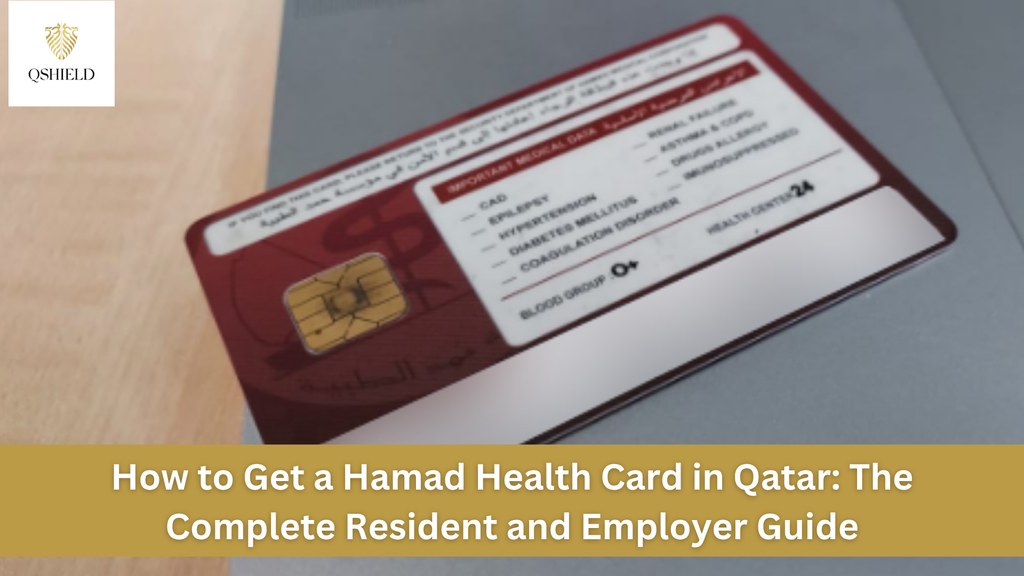
The Hamad Health Card is an official identification document issued by the Qatari government that grants the holder access to the public healthcare system at heavily subsidized rates. The public healthcare network in Qatar is fundamentally divided into two tiers:
- Primary Health Care Corporation (PHCC): These are local health centers distributed across various residential zones. They act as the first point of contact for routine medical needs, general consultations, vaccinations, basic dental care, and minor treatments.
- Hamad Medical Corporation (HMC): This is the principal public hospital provider. HMC handles complex medical procedures, emergency and trauma care, specialized surgeries, maternity services, cancer treatments, and advanced clinical diagnostics.
Generally, patients cannot simply walk into an HMC specialist clinic; they must first visit their designated PHCC health center. If the primary care physician determines that specialized treatment is required, they will issue a medical referral to HMC.
It is important to note that in life-threatening emergencies, HMC provides urgent care to everyone regardless of whether they hold a valid health card. However, for all non-emergency, routine, and specialist outpatient consultations, presenting a valid Hamad Health Card is mandatory to avoid paying exorbitant out-of-pocket medical fees. Furthermore, the health card connects you to the ‘MyHealth’ patient portal, a centralized digital record that tracks your medical history, prescriptions, and lab results across all public health facilities.
Understanding the Fee Structure
The Qatari government has standardized the fees for issuing and renewing the Hamad Health Card, ensuring that access to public healthcare remains affordable for all demographic groups. The fee structure is categorized by nationality and residency status.
The currently listed fees for the Hamad Health Card are as follows:
- Expatriate Residents (Adults and Children): QAR 100
- Qatari Citizens (Adults and Children): QAR 50
- GCC Citizens (Adults and Children): QAR 50
- Domestic Workers and Manual Laborers: QAR 50
References:
https://hamad.qa/EN/Patient-Information/How-To-Get-A-Health-Card/Pages/default.aspx
https://www.phcc.gov.qa/patients-clients/health-card
Given the high quality of care provided by HMC and PHCC, this nominal annual fee represents exceptional value for residents, subsidizing the true cost of medical consultations, diagnostic imaging, and prescription medications.
Required Documents for Application
Before initiating the application process, applicants must gather specific documentation to verify their identity and residential address. Ensuring these documents are accurate will prevent unnecessary delays.
Depending on the applicant’s category, the primary documents required include:
- Valid Qatar ID (QID): A clear copy of the applicant’s valid QID is mandatory. The system generally requires the QID to have substantial validity remaining.
- Passport Copy: A clear copy of the applicant’s passport.
- Photographs: A recent passport-size photograph (typically 4cm x 3cm).
- Proof of Residential Address: The government assigns individuals to specific PHCCs (health centres) based on geographical location. To prove residence, applicants must provide a recent Kahramaa (utility) bill or a registered tenancy contract.
- Special Exemption: If the utility bill is in a landlord’s name, a copy of that bill along with the tenancy agreement is usually sufficient. Single workers living in company-provided accommodation may not need to provide a personal utility bill. Instead, they can submit an official sponsorship letter or accommodation certificate from their employer.
- For Children: When applying for a child’s first health card, their official vaccination card must be provided.
- For Dependents: The sponsor’s QID may be requested for certain dependent or domestic-worker applications.
Step-by-Step Guide: How to Apply Online
Residents can now start their health card registration online, without waiting in a physical queue. The process has been seamlessly integrated into digital platforms such as the Hukoomi portal and the Nar’aakom mobile application.
1. Download the Nar’aakom App:
Install the Nar’aakom application on your smartphone. It is the official app for the Primary Health Care Corporation (PHCC).
2. Select Your Preferred Language:
Upon launching the application, choose English or Arabic to navigate the interface comfortably.
3. Log In via Tawtheeq:
Access the system securely by logging in to the National Authentication System (NAS), known as Tawtheeq. You will need to enter your QID number and your designated NAS password.
4. Access the E-Services Portal:
In the app, go to the e-services section and select “Register for New Health Card.”
5. Fill in Applicant Details:
Select whether the application is for yourself or an eligible dependent. Carefully enter all the required personal information and contact details.
6. Upload the Required Documents:
Upload clear, legible digital copies of your valid QID and your proof of address (such as the Rental Contract or Kahramaa bill).
7. Pay Fees and Receive Confirmation:
Click Submit, and follow the prompts to complete the payment securely using a credit or debit card. Upon successful processing, you will receive a confirmation.
Step-by-Step Guide: How to Apply Offline
For people who prefer to complete administrative processes in person or face issues with the online portal, applying offline is an accessible option.
1. Visit the Nearest PHCC Facility:
Find and visit the Primary Health Care Corporation (PHCC) centre assigned to your residential area. Health center zoning is strictly enforced to manage patient loads effectively.
2. Fill Out the Application Form:
Approach the patient registration desk and request a health card application form. Complete it thoroughly.
3. Submit Required Documents:
Hand over all required documentation to the registration staff. This includes your valid QID, passport-size photo, and proof of residential address.
4. Pay the Required Fee:
Please note that most government facilities are cashless. Payment must be made by debit or credit card, as cash is generally not accepted.
5. Collect Your Health Card:
Residents can now use their Qatar ID (QID) instead of a physical health card when accessing public healthcare services. There is no need to collect or carry a separate health card.*
*References:
https://hukoomi.gov.qa/en/news/moph-announces-adopting-qid-card-or-residents-in-place-of-health-card
Health Card Renewals and Replacements
A Hamad Health Card is not valid permanently. It must be renewed regularly, usually every year. The renewal process is highly streamlined and can be entirely executed online via the Hukoomi portal. Users simply input their QID number, select “Renew,” and process the payment digitally.
If a health card is lost or severely damaged, it must be replaced. The process for requesting a replacement is identical to the renewal procedure on Hukoomi, and the replacement fee remains QAR 100 for expatriate residents*. It is highly recommended to memorize your health card number or keep a digital scan on your phone, as you can still book appointments via the ‘Nesma’ak’ helpline (16060) if you know your number.
* Date: 19 April 2026 01:30 PM
References:
https://www.phcc.gov.qa/patients-clients/health-card
https://www.hamad.qa/en/patient-information/how-to-get-a-health-card/pages/default.aspx
Conclusion: Simplify Your Corporate Mobility with QShield
Managing the intricacies of employee onboarding, residency issuance, and healthcare compliance in Qatar requires precision and up-to-date regulatory knowledge. Ensuring that your workforce navigates processes like obtaining their Qatar IDs, securing mandatory private health insurance, and successfully applying for their Hamad Health Cards can easily strain an internal HR department.
This is where QShield elevates your operational efficiency. As Qatar’s premier corporate PRO and global mobility advisory, we specialize in removing administrative friction in market entry and workforce management. Our dedicated experts manage the entire lifecycle of corporate immigration, from labor quota approvals and visa issuance to medical commission scheduling and ongoing compliance audits.
Do not let regulatory complexities slow down your business operations. Partner with QShield today to ensure your company remains fully compliant and your international workforce is mobilized seamlessly, legally, and professionally.